

A spread-versus-error framework to reliably quantify the potential for subseasonal windows of forecast opportunity
15.05.2026
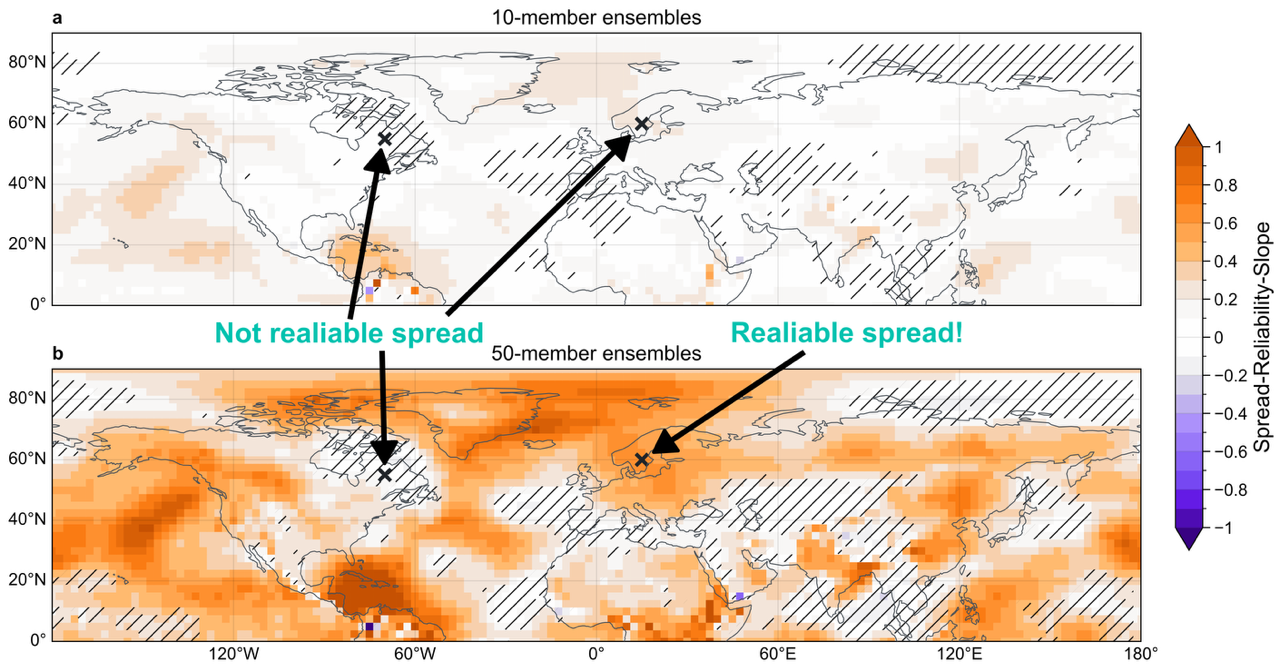
Figure: A measure of the reliability of subseasonal forecasts: values of 1 would indicate perfect reliability, with small or negative values implying reduced or lacking reliability. Top and bottom compare results from ensembles of different sizes.
Weather forecasts at so-called subseasonal time scales (2-6 weeks ahead) provide a bridge between conventional (medium range) forecasts (lead times of up to 2 weeks) and forecasts for seasonal means. Due to atmospheric "chaos" these subseasonal forecasts are highly uncertain. This uncertainty can be quantified by running many identical forecasts with slightly different initial conditions. The spread of such ensemble forecasts provides useful information about forecast uncertainty. This ensemble spread can change depending on large-scale atmospheric conditions, for example due to large-scale disruptions of the stratospheric flow during polar winter (so-called sudden stratospheric warmings).
We present a new way to measure how well subseasonal forecasts capture fluctuations in uncertainty. Our results show that reliability of uncertainty is linked to slow, predictable patterns in the atmosphere and varies strongly with region and the ensemble size of the forecast. These findings help identify periods when forecasts are more trustworthy.
Recent paper abstract and link
Mid-latitude forecast skill at subseasonal timescales often depends on “windows of opportunity” that may be opened by slowly varying modes such as El-Nino-Southern-Oscillation ENSO, the Madden-Julian-Oszillation MJO or stratospheric variability. Most previous work has focused on the predictability of ensemble-mean states, with less attention paid to the reliability of such forecasts and how it relates to ensemble spread, which directly reflects intrinsic forecast uncertainty. Here, we introduce a spread-versus-error framework based on the Spread-Reliability Slope (SRS) to quantify whether fluctuations in ensemble spread provide reliable information about variations in forecast error. Using ECMWF Sub-seasonal-to-Seasonal (S2S) forecasts and reanalysis data (ERA5), aided by idealised toy-model experiments, we show that spread reliability is controlled by at least three intertwined factors: (1) sampling error, (2) the magnitude of physically driven spread variability and (3) model fidelity in representing that variability. Regions such as northern Europe, the mid-east Pacific, and the tropical west Pacific exhibit robustly high SRS values (i.e. reliable spread fluctuations) for 50-member ensembles, consistent with robust spread modulation by slowly varying teleconnections. In contrast, areas like eastern Canada show very low SRS (little or no spread reliability), even for 100-member ensembles, reflecting limited low-frequency modulation of forecast uncertainty. We further demonstrate two practical implications: (i) a simple variance rescaling yields a postprocessed “corrected spread” that enforces reliability and may help to bridge ensemble output with user needs; and (ii) time averaging effectively boosts ensemble size, allowing even 10-member ensembles to achieve reliability of spread fluctuations comparable to larger ensembles. Finally, we discuss possible links to the signal-to-noise paradox and emphasize that adequate representation of ensemble spread variability is crucial for exploiting subseasonal windows of opportunity.
- Rupp, P., Spaeth, J., and Birner, T.: A spread-versus-error framework to reliably quantify the potential for subseasonal windows of forecast opportunity, Weather Clim. Dynam., 7, 767–785, https://doi.org/10.5194/wcd-7-767-2026, 2026.