

Applying machine learning to derive cloud properties from solar satellite data for data assimilation
01.07.2026
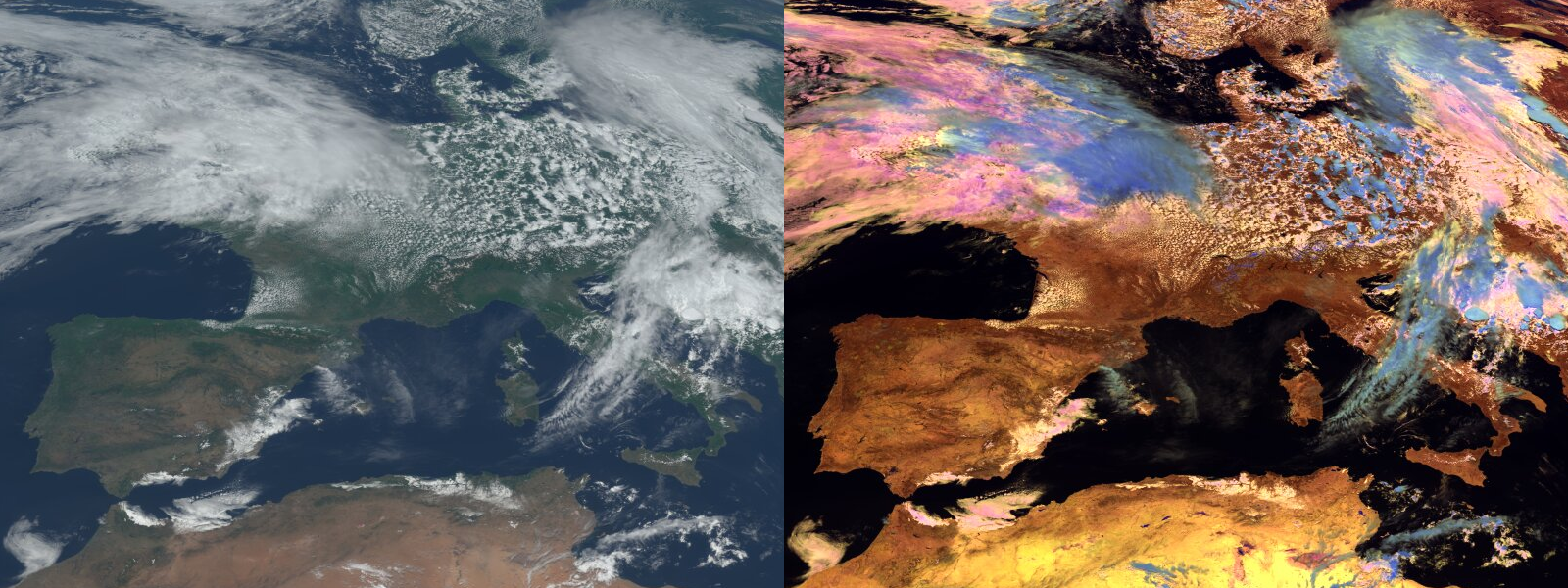
True colours composite of 0.4, 0.5, 0.6 and 0.8μm Meteosat Third Generation (MTG) visible channels at 12UTC of 11 June 2026 (left), and cloud phase composite of 0.6, 1.6 and 2.2μm channels (right). 1.6 and 2.2μm are near infrared channels, and show independent information on cloud phase compared to visible channels.
As the quality of weather forecasts also depends on the accuracy of their initial conditions, continuously improving these conditions is essential. The best estimate of the current state of the atmosphere is conventionally obtained via a statistical procedure called data assimilation, which combines two sources of information: observations and a short-range forecast (typically ranging from 1 to 6 hours). The short-range forecast is compared to the observations thanks to forward operators, i.e., functions that simulate the measurements using the atmospheric state represented in the model.
Satellite observations in the solar part of the spectrum (including visible and near-infrared channels) offer high-resolution information on clouds and atmospheric properties, and therefore have significant potential for data assimilation. While forward operators suitable for assimilating these observations have become available recently and a first visible channel is already used operationally, their joint assimilation remains challenging because of the specific characteristics of the associated forward operator (for example, non-linearity and ambiguity) and their high inter-channel correlations.
The objectives of this study are twofold: first, to quantify the situation-dependent joint information content of multiple solar channels independently of the data assimilation system, and, second, to determine whether the observed reflectances can be transformed into physically meaningful variables with quantified uncertainties that are better suited for assimilation than the raw reflectances themselves. To this end, we present the "Backward Operator" (BO), a machine learning-based method implemented as a distributional regression network to compute probabilistic retrievals of cloud properties (e.g., cloud optical thickness and ice fraction) using the solar channel reflectances of the Meteosat Third Generation satellite. BO is designed to partially and approximately invert the forward operator, allowing to quantify the joint information content of the input channels. The results show that the probabilistic retrievals are reliable and usefully constrained, and it provides insights into the joint information content of this set of solar channels. The design of BO and its reliable, situation-dependent uncertainty estimates, make it suitable for data assimilation. In addition, combining multiple visible channels showed a significant performance improvement, despite their high inter-channel correlations.
Franzoni, S., C. Bülte, L. Scheck, C. Keil, G.C. Craig (2026): Using Distributional Regression Networks to Retrieve Cloud Properties from Solar Satellite Channels for Data Assimilation. Q. J. Roy. Meteorol. Soc., under review, Preprint: https://arxiv.org/abs/2606.21294